


 There’s a sea change underway shaping the way we all communicate. No longer limited to a specific device, people enjoy the freedom to seamlessly network with friends and co-workers, watch videos, share photos, or generally wander the Net 24×7 – wherever and whenever they choose. NewBay’s Steve French maps out the new landscape and impact on all the players — particularly mobile operators and device makers.
Today’s rich communication experience doesn’t just transform how we connect and communicate with our friends, families and social networks. It also encourages us to create and share content, including user- generated content (UGC) and premium content. At the other end of the spectrum, content delivery and social networking have converged with developments in cloud-based storage, device innovation and the advance of ubiquitous broadband to enable new experiences that were not possible in the past.
The result: We have a new appetite for content (including photos, videos, music, documents, messages and contacts in our digital devices) and we have little patience with providers that fail to deliver us what we want (on our terms) and securely store what we hold dear.
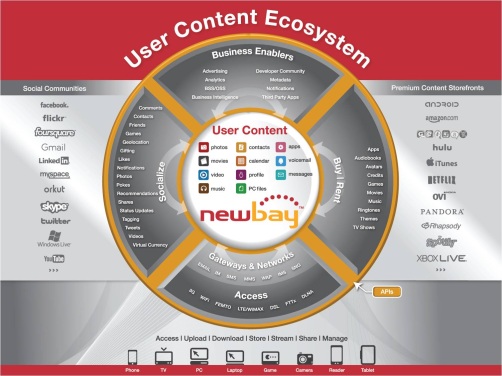
Against this backdrop, a new User Content Ecosystem is evolving to support the development (and variety) of our digital content experiences. It’s a seismic shift that will rock the industry landscape and result in new opportunities (and issues) for mobile operators and device makers.
What does this new ecosystem look like and who sits where?
Allow me to guide you through my view of the players — and what’s at stake.
Old players, new rules
As with all diagrams that depict our evolving business ecosystems, the individual is the focus. In this case, user content is at the heart of this new paradigm. By user content I mean both UGC and premium content. But it’s not so much about what people make and consume; it’s how they interact with content that changes all the rules. Specifically, people want access (entirely on their terms) to this store of digital content. To achieve this they upload their content to a digital vault, where it can be stored, managed, enriched and shared with friends and family or with their favorite social communities. And it’s not just about mobile phones. People demand this capability from any connected device.
Social communities have similar requirements. There are as many kinds of communities as there are members. In fact, we are witnessing the proliferation of social networks, not unlike the legendary Long Tail of content we know from the Internet. From local social networks (such as Renren in China) to groups of people looking for dating fun (such as Flirtomatic), each community differs in the content they generate. But they all have a common objective: to encourage and enjoy socializing, networking and entertainment.
Content for sale & storage
Premium content is also moving to the fore as storefronts like Amazon.com, Netflix, iTunes and hulu expand to feed our growing appetite for mobile entertainment. In addition, 100+ mobile app stores have opened their doors, offering us a fantastic variety of applications and turning up the pressure on mobile operators and device makers to help us store our pick of apps so we can access them when (and how) we want.
In fact, a new study from ABI Research reveals that the worldwide app industry is well on its way to achieving 44 billion cumulative downloads by 2016. The mobile app ecosystem and market model is also expected to evolve with the increasing pool of smartphone and tablet users.
Whether it’s storefronts or apps, consumers are using them to get the content they want – the way they want it. They rent premium content (movies, TV shows, games, music and apps) and stream it to their devices. Or they purchase the content, move it into their digital vault for safe keeping, or download it to their device for offline viewing.
Big Business (Enablers)
And then there are the business enablers, the underlying systems and processes that help support and monetize digital content. They bring important capabilities to the mix, providing ecosystem partners with deep insights into the key numbers, metrics and concrete results that are the lifeblood of the content business. These range from advertising and analytics, to business intelligence (BI) and billing.
Next in line is infrastructure and network resources. These gateways enable consumers to upload, download, store, stream, share, and manage content from different devices and screens. In other words, access entirely on the consumer’s terms – the way it has to be.
This choice — what I also call Access Independence — is critical to the success of the ecosystem. The movement to network technologies including 3G, long term evolution (LTE) and WiMAX provides speed and reliability. These are mission-critical when the end-game is about ensuring a consistent and gratifying user experience across all screens.
Screens everywhere
The issues around content storage and access are further complicated by a proliferation of connected devices. From smartphones to tablets, and from games consoles to Kindles, users have (and have come to demand) many more choices for accessing, sharing and organizing their content. In fact, our requirement for multi-screen (and consistent) content access and distribution is one of the main drivers for the Cloud. Consumers want to put their content in the cloud — and the ecosystem is emerging to make this possible.
How? In part through application programming interfaces (APIs). These are the glue that hold our new content ecosystem together, enabling systems to speak and interact with each other and give way to new forms of entertainment and a lifetime of digital content user experiences.
Change happens
Where does this leave mobile operators and device makers? How can they take advantage of the new digital content experiences and secure their own role in this new User Content Ecosystem?
Before we can discuss the opportunities we have to accept that command-and-control models belong in the past. They are not sustainable, and they do not cultivate the community needed to make this new ecosystem thrive and flourish.
Put simply, the walled-garden business model that flourished before (in which telecom operators tightly controlled voice, data services and our access to content) is no longer viable.
In this new landscape, operators have to accept some harsh truths in order to grasp the business opportunities around them.
Out of control: Operators have less control over subscribers, services, content and devices. Their historical dominance of the value chain is under attack, and their previously exclusive relationship with subscribers is eroding.
People go where the content is: Users are now taking their dollars and turning to new storefronts like iTunes, Android, Netflix, and Amazon to satisfy their appetite for games, music, movies, TV and more. Their mobile experience is also no longer limited to the mobile phone and operator. Readers, tablets, gaming consoles, connected laptops, and TVs all serve as portals for accessing, uploading, sharing, and managing personal and business content.
Networks are the destination: The popularity of social networking sites like Facebook, Twitter and LinkedIn is exploding, forming the heart of many users’ online experience. The business enablers of the new paradigm like advertising, analytics and third-party applications are largely evolving outside of the operators’ province.
Granted, operators can no longer dominate the telecom landscape, but they can still play a significant role (and not just be relegated to the role of a “dumb pipe”). In fact, they can even sit at the center of this new User Content Ecosystem, provided they build the capabilities that allow them to act as the central hub between the users (devices), social networks and premium storefronts.
From this position operators and device makers alike can leverage metadata, analytics, notifications and developer communities to create new revenue streams from subscription fees, advertising, premium content sales and extending lifetime value.
It’s a new business model that will separate the winners from the also-rans, and I will explore the options available to all the ecosystem players (and more!) in upcoming articles.
Steve French is VP Global Marketing, NewBay. NewBay enables operators and device makers to deliver a lifetime of digital content experiences across any connected device such as mobile, PC, tablets and TV. To find out more about this and other related topics check out the NewBay Blog at www.newbay.com/blog.
Editor’s note: Learn more about increasing the service adoption, usage, longevity, profitability and lifetime value of services by joining NewBay’s upcoming webinar on real-time push notifications.

“Discover Real-Time Push Notifications for Any Service, Any Device and Any Delivery Mechanism” will be held on Tuesday, 3rd May at 5 pm GMT (London) / 9 am PST (San Francisco).